
Video Production
Video Production for Singapore SMEs: What 600+ Projects Taught Us About Getting It Right
A logistics company in Tuas came to us wanting a “brand film.” A cinematic piece about their founding story, their team, and their journey from a single truck to a regional operation. We made it. It looked excellent. Six months later, the owner told us frankly: he gained zero clients in half a year. Instead

In this article
A logistics company in Tuas came to us wanting a “brand film.” A cinematic piece about their founding story, their team, and their journey from a single truck to a regional operation. We made it. It looked excellent. Six months later, the owner told us frankly: he gained zero clients in half a year.
Instead of a brand film, they needed a 90-second explainer showing exactly what their cross-border freight service covers and how to get a quote. We made that later, too. Became their most-used sales tool.
Since 2012, we have worked with 600+ businesses as a video production company in Singapore, the majority being SMEs. So, we know how SME companies run, where every dollar spent means business.
This guide is written from that position. Not from a marketing textbook, but from a decade of watching what works, what doesn’t, and what SMEs consistently get wrong when they commission video.
Why Is a Production House Perspective Different?
Most video marketing advice is written by marketers. It tells you what to create. We’re practitioners. We can tell you what actually happens when you try.
Working with SMEs is fundamentally different from working with enterprise clients. There’s no agency layer. The decision-maker is usually in the room or on the shoot. Budgets are fixed, not fluid. And the video has to do something for the business, not just exist as branded content.
That’s the lens we use in this guide, one built from running a video production company in Singapore that works almost exclusively on projects where revenue impact is the only metric that matters.
The Five Videos Singapore SMEs Actually Need
Many production houses will try to sell you what looks best on their showreel. We prefer to build what actually impacts your bottom line. Based on our extensive data, here are the most ROI-making video formats.
1. Product or Service Explainer Videos
If you offer something that takes more than two sentences to explain, you need an explainer video. These are the highest-ROI videos for SMEs because they do the job of your best salesperson, at scale, without variation.
According to Wyzowl’s research, 96% of consumers have watched an explainer video to learn about a product or service. For B2B video production, especially for engineering services, logistics providers, and IT consultancies, this is where SME video marketing investment pays for itself fastest.
We’ve worked with corporate clients across Singapore where a single well-made explainer video replaced the hundreds of cold openings. One technical services firm reported its sales team spent 40% less time on initial calls after embedding an explainer on its enquiry page.
Best for: B2B services, technical products, multi-step processes, anything that benefits from showing rather than telling.
2. Customer Testimonial Videos
Trust is the biggest barrier to a first purchase, and for SMEs competing against larger brands, it’s the hardest thing to manufacture. Authentic testimonial videos solve this.
The keyword is authentic; genuine. A scripted testimonial filmed in a studio with a professional actor is immediately recognizable as advertising. Real clients, speaking in their own words, even fumbling a few words, feel more credible than any paid promotion. Rough edges are fine; what matters is sincerity and trust. Our corporate video production process includes on-camera coaching so your real clients feel at ease, not like reluctant actors.
Best for: Service businesses, B2B companies with a longer sales cycle, and anyone where social proof accelerates decisions.
3. Recruitment Videos
A precision engineering firm in Woodlands was consistently losing top technical talent to larger multinational corporations. We developed a recruitment-focused corporate video production that highlighted their tight-knit culture, direct access to the management team, and clear, rapid career progression paths.
For SMEs, competing purely on salary alone is often a losing battle. A well-crafted recruitment video bridges that gap by showcasing the human element of your workplace. It allows potential hires to see what they can actually expect, transparently.
We’ve produced many recruitment-focused corporate videos for engineering firms and specialist consultancies in Singapore, where the video became a standard part of the HR process.
Best for: Companies in competitive hiring sectors, SMEs that want to attract talent without relying solely on salary packages.
4. Social Media Content
SME owners often come to us wanting videos that “go viral.” We have to reframe that conversation. For B2B SMEs, going viral is the wrong goal. Value is the right goal.
Short educational videos, in some cases, matter more than any “viral” campaign. For example, we worked with a B2B heavy machinery supplier in Jurong to create a series of short, highly educational maintenance tips. By batch-producing 12 short videos in a single day of shooting, we kept the production costs extremely low.
The videos built authority and stayed in front of their audience without hard-selling for months. Those videos made them industry authorities on LinkedIn, far outperforming any generic promotional posts. For SMEs that want to extend content into paid channels, our commercial video production work covers short-form ad formats built for performance.
Best for: B2B service providers, professional services firms, any SME that wants a consistent content presence without constant production spend.
5. Event Coverage
Every business milestone, an industry talk, a product launch, a client workshop, is an unrepeatable asset. Without video, it disappears. With professional event video production, it becomes a marketing tool that works for months.
Event coverage from a professional event video production team gives you highlight reels for social, full recordings for internal use, and speaker cutdowns for LinkedIn. One workshop becomes a library of content. This is especially valuable for SMEs that don’t have regular product news to push. Your events become your content calendar.
Best for: Training companies, professional associations, and any SME that hosts regular business events.
Three Ways SME Video Projects Fail (And How to Avoid Them)
Credibility comes from absolute honesty. We haven’t just seen successes; we have seen (and learned critical lessons from) outright failures. Here are three common traps in video production that Singapore SMEs repeatedly fall into.
Failure #1: Making a Brand Film When You Need Lead Generation
This is the logistics story from the introduction, and it’s extremely common. Brand films are aspirational. They build awareness and emotional connection over time. They are not lead generation tools.
If your business goal is to bring in new clients this quarter, your video goal should be to answer the prospect’s most common objection or explain the thing that’s confusing people. Define your business outcome first, then work backwards to the video type.
The fix: Before briefing any production company, complete this sentence: “After watching this video, I want the viewer to ___.” If the answer is vague, the brief will be too.
Failure #2: Trying to Speak to Everyone in One Video
A mid-sized manufacturing client tried to create a single, all-encompassing video that spoke to corporate buyers, future entry-level employees, and potential investors simultaneously. The result was a confusing five-minute mess that resonated with one of them.
SMEs have multiple audiences, but each video should speak to one of them. A video made for employees and a video for potential clients are two different videos. Different language, concerns, and most importantly, calls to action.
The fix: Accept that you may need two or three shorter, targeted videos rather than one comprehensive one. Multiple targeted videos almost always outperform a single catch-all piece.
Failure #3: Perfectionism That Kills Timeliness
We’ve had projects sit in review cycles for four months. By the time they were approved, the product had changed, a key team member had left, and the seasonal relevance was gone. The video, technically excellent, was functionally useless.
SMEs face real-time pressure. A “good enough, shipped” video that prospects can watch this week is worth more than a perfect video they’ll see after the quarter ends.
The fix: Set revision limits in your production agreement; two rounds are standard. Assign one internal decision-maker with final approval authority. Agree on a hard delivery date at the start of the project.
How Singapore SMEs Actually Use Video (The Unglamorous Reality)
Forget the glamorous, Hollywood idea of a video going viral and crashing your website with traffic. The real power of video production that Singapore SMEs can leverage lies in highly tactical, unglamorous, day-to-day business operations.
|
Usage Method |
How It Works |
Effectiveness |
|
Direct to prospects via email or WhatsApp |
Sent during active sales conversations to replace or supplement a call |
High: personalizes outreach without extra effort |
|
Embedded on specific service pages |
Not homepage heroes, but targeted landing pages for each service |
High: informs prospects before they call, improves lead quality |
|
Sent between interview stages |
HR teams share recruitment videos to set expectations for shortlisted candidates |
Medium-high: reduces candidate drop-off |
|
Played during in-person meetings |
Sales teams open client pitches with a short explainer or testimonial reel |
High: standardizes messaging across different salespeople |
SMEs mostly use video as a tool in a process, not a broadcast medium. They embed it into existing sales, operations and hiring workflows, making the process more efficient.
Choosing the Right Production Partner: What Actually Matters
There are too many video production options in Singapore for SMEs to evaluate alone; we know, because we are one of them.
Look for Demonstrated SME Experience
Do not be blinded by a glossy portfolio filled with multinational banks, global tech giants, and massive government campaigns. As impressive as they might sound, most production houses fill their reels with projects at a scale the average SME will never commission. The production approach, communication style, and result are not the same.
Ask to see portfolio work from companies at your scale, in industries close to yours.
A reel full of MNC brands and nothing that resembles your business is a clear red flag. Our corporate video production portfolio spans SMEs across manufacturing, logistics, recruitment, and professional services — all at a scale that reflects real business budgets.
Pay Attention to How They Communicate During the Inquiry
Before you sign anything, pay attention to how they communicate. Do they ask you questions about your business goals, or do they immediately pitch you a concept? Are they closely listening to your success metrics or throwing everything and expecting something to catch on?
A good production partner asks the tough questions which others avoid.
- What problem are you trying to solve?
- Have you tried this before?
- Was there any previous similar campaign that showed underperforming results?
- Who specifically needs to watch this?
These are the questions that prevent the expensive mistakes described above. Explore the full range of video production services available and bring specific questions to every conversation.
Understand What “Full Service” Actually Means for SMEs
When a small business video production mentions “full-service” support, it doesn’t mean showing up to shoot and edit. It means comprehensive assistance with scriptwriting because you likely don’t have an in-house copywriter. It means patient, empathetic on-camera coaching for your nervous leadership team. It means highly flexible scheduling to minimize disruption to your daily operations.
That’s why we always encourage SMEs to review our portfolio to see the range of work we’ve done for businesses like theirs across Singapore.
Be Cautious of Aggressive First-Project Discounts
Heavily discounted first projects often come with a catch. Higher rates on repeat work, limited revisions, or reduced support. Consistent, relationship-based pricing is a better signal of a partner who’s invested in your long-term results.
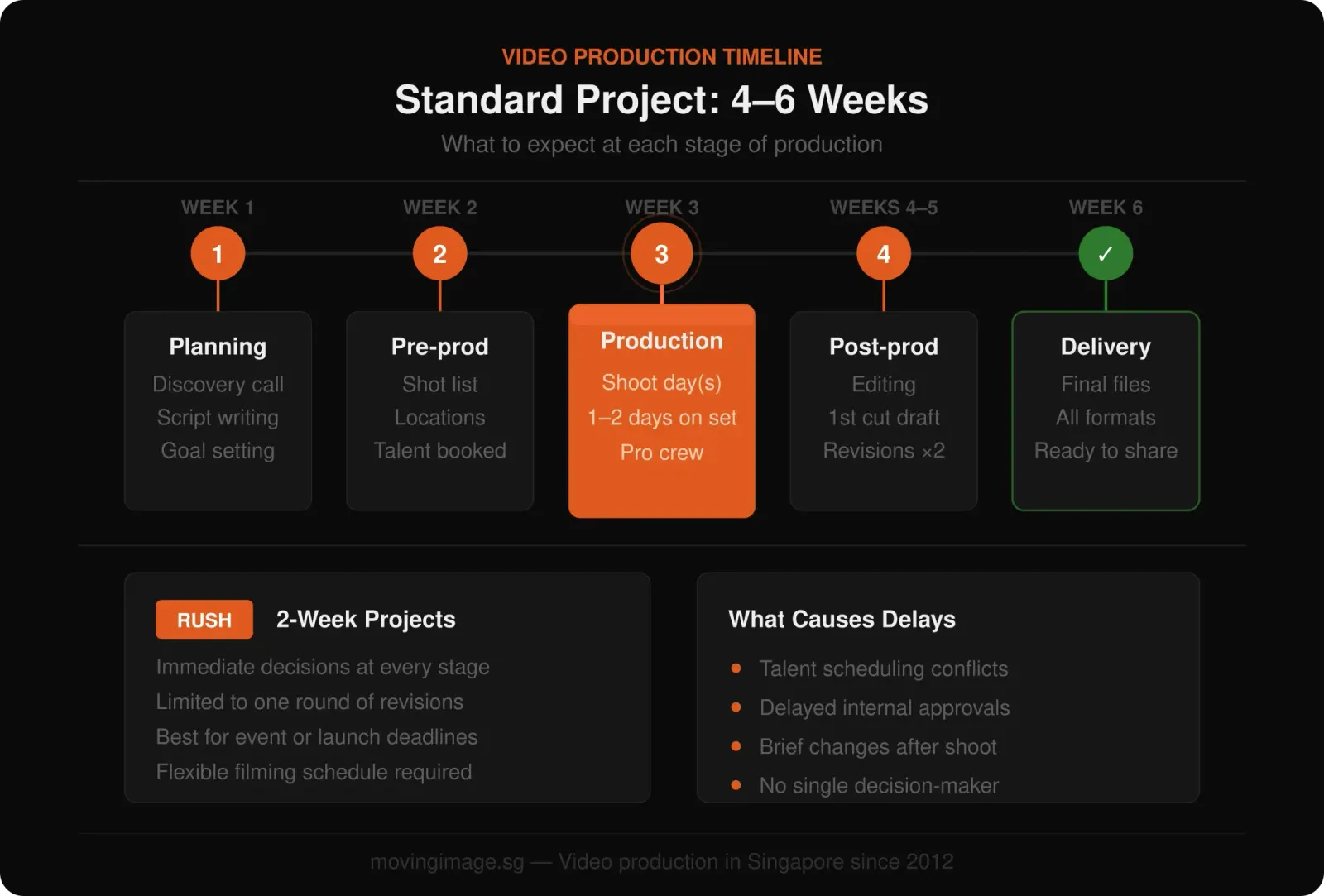
Realistic Timelines: What to Expect
One of the most common frustrations in SME video projects is mismatched expectations on the timeline. Here’s a straightforward breakdown.
Rush Projects (2 Week Timeline)
Can a project be executed faster? Yes. But projects require absolute commitment from your side: immediate, same-day client decisions, highly flexible filming schedules, and strict limitations on post-production revisions. This intense compression is usually only justified for hard, immovable, time-sensitive opportunities like an upcoming major trade show or a sudden PR crisis.
What Slows Projects Down
The uncomfortable truth of production? The vast majority of delays are client-side. The primary bottlenecks are almost always scheduling busy internal stakeholders for their interviews, delayed feedback on script drafts, and ambiguous revision requests (e.g., “can you just make it pop more?”). Clear communication and assigning a single, dedicated internal point-person on your end prevents 90% of these delays.
Common Questions from SMEs
Production company vs. freelancer?
Freelancers work well for simple, low-complexity projects. For anything requiring scripting, on-camera coaching, and multiple deliverable formats, a video production company in Singapore provides the structure to manage it efficiently. Choose based on what you’re making, not how much you want to spend.
Can SMEs produce video in-house with a smartphone?
For certain formats, yes. Internal team updates, quick social posts, and behind-the-scenes content can work well on a smartphone. Where in-house production typically fails is anything client-facing. Explainers, testimonials, or recruitment videos where poor audio or unstable footage quietly signals that your business cuts corners.
Does production quality affect credibility?
Yes, but not the way most people think. You don’t necessarily need cinematic values. What you need is clear audio, stable footage, and adequate lighting. Wyzowl’s research shows 89% of consumers say video quality impacts their trust in a brand. Poor audio is the single biggest credibility killer.
How many videos per year?
We observe three patterns in our client base: minimum (1-2 per year: an explainer and a testimonial), active (4-6 videos batched across two shoot days), and aggressive (monthly content for companies where content drives pipeline). Start at minimum and measure lead quality improvement, then scale.
Should the owner appear on camera?
Usually yes. Authenticity consistently outperforms polish for SMEs. An owner speaking directly about what they do and why resonates more than a seasoned actor reading a script. On-camera coaching makes an immediate difference for anyone nervous.
How do SMEs actually measure video ROI?
Skip vanity metrics like views and watch time. The three measurements that matter for SME video marketing are: sales cycle length, lead quality, drop-off rate in hiring. These don’t require analytics tools. They require asking your sales and HR team one question every quarter: is this working?
What to Do Right Now If You’re Considering Video Production?
- Define your primary goal: Do you urgently need more inbound leads, faster sales cycles, or higher-quality job applicants?
- Identify your most important video: What piece of content would do the most work for your business if it existed right now?
- Document the problem: What is your salesperson saying that this video would replace or support?
- Set a realistic internal timeline: Who will be in the video? Who has approval authority? What is your delivery deadline?
- Talk to 2–3 production partners: Get multiple quotes while checking who asks the best questions about your business. Browse our work to see how we have handled briefs across industries and SME sizes before reaching out.
That’s why we’d rather spend 30 minutes understanding your situation than send you a proposal that doesn’t fit your actual needs.
The Bottom Line
Video works for Singapore SMEs, and our project experience reflects that. But it only works when it’s built around a specific business problem, targeted at a specific audience, and deployed in the right place in your sales or marketing process.
What works for SMEs:
- Explainers that answer your prospects’ real questions
- Testimonials featuring real clients in their own words
- Video embedded into existing sales workflows, not broadcast content
- Batch production to maximize output from a single shoot day
- One decision-maker, clear revision limits, firm deadlines
What doesn’t work:
- Brand films when the goal is lead generation
- One video trying to speak to every audience
- Perfectionism over shipping
- Choosing a partner based on their MNC portfolio
If you’re ready to make your first or next video, get in touch. We’re a video production company in Singapore specializing in video production for Singapore SMEs since 2012, and we’ll tell you honestly what your business needs, even if it’s too out of the box.


