
Video Production
What Is End-to-End Corporate Video Production? An Honest Process Guide
You’ve decided your company needs a corporate video. Maybe it’s a company profile, a product explainer, or a recruitment film. You’ve seen production companies describe themselves as “full-service” or “end-to-end,” and you’re probably wondering what those actually mean before the invoice arrives. More to the point: what happens between the first briefing call and the

In this article
You’ve decided your company needs a corporate video. Maybe it’s a company profile, a product explainer, or a recruitment film. You’ve seen production companies describe themselves as “full-service” or “end-to-end,” and you’re probably wondering what those actually mean before the invoice arrives.
More to the point: what happens between the first briefing call and the final video file hitting your inbox?
This guide walks through the complete end-to-end corporate video production process – every phase, who does what, and what your involvement looks like at each step. No jargon, no sales pitch. Only the process is clearly explained.
What “End-to-End” Really Means in Corporate Video Production
End-to-end corporate video production means one company manages every phase – from concept and script through filming, editing, and final delivery. You’re not juggling a separate scriptwriter, a filming crew, and an editing studio. One team owns the whole process, making your corporate video production seamless.
What’s typically offered by a full-service production team:
- Creative development and concept
- Scriptwriting and storyboarding
- Pre-production planning (locations, casting, scheduling)
- Professional filming with a full crew
- Post-production: editing, colour grading, sound design, motion graphics
- Revision rounds
- Final delivery in all required formats
What’s not covered:
- Marketing strategy or campaign planning
- Paid media buying
- Website development
- Ongoing series management, unless that’s been separately agreed
That last point matters more than people realise. End-to-end refers to the production process. It’s not a catch-all for your broader content or marketing operation, and confusing the two is where most scope disputes begin.
How the production models compare:
|
Model |
You Manage |
Works Best When |
|
DIY |
Everything |
Budget is the main constraint |
|
Piecemeal/Hybrid |
Vendor coordination |
You have in-house project management capacity |
|
End-to-End |
Feedback and approvals |
Your team doesn’t have time to babysit the process |
In Singapore, the single-vendor model is the default for most corporate productions. Teams here tend to value clear timelines and clean handoffs, and chasing multiple vendors for updates doesn’t fit that way of working.
Phase 1: Pre-Production – Concept, Script, and Planning
Typical duration: 1-3 weeks
Pre-production is where the video stops being an idea and becomes a plan someone can actually execute. It’s also the phase that’s most often underestimated. Skipping steps here doesn’t speed the project up. It just moves the problems to filming day, where fixing them costs real money.
Step 1: Creative Brief and Concept Development (2-4 days)
The production company sits down with your team to nail down the basics: what the video needs to do, who it’s for, what the key messages are, where it’ll be used, and what constraints exist on budget and timeline. This becomes a written creative brief that everyone refers back to throughout the project.
For corporate businesses, you’ll need to be prepared with a few things: clear answers, your brand assets (logos, guidelines, any previous videos), and one single point of contact & authority. Committees are fine for input, but you want a single sign-off point.
A Singapore example: A fintech company briefing a company profile video might specify –
- Audience: institutional investors
- Tone: confident but not flashy
- Required content: the Singapore office and core team
- Distribution: investor decks and the website homepage
Step 2: Scriptwriting (3-7 days)
A video script is not a repackaged version of your website copy. It’s written to be heard, not read. That means mostly shorter sentences, more direct language, and a structure that works when someone is watching rather than scanning. A two-minute video runs roughly 250-300 words when spoken at a natural pace.
What you need to bring is the final draft review for factual accuracy, consolidated feedback into one submission, and then sign off. The most avoidable delay in pre-production is multiple people sending separate notes at separate times. Collect everything first, and send it once.
Step 3: Storyboard Development (2-5 days)
Once the script is locked, the production company maps it visually. The storyboard shows the key shots frame by frame; camera angles, composition, where text and graphics sit, and how scenes transition. It’s the complete blueprint for filming day.
This is also your last real chance to catch misalignments before the crew is standing in your office. If you pictured your CEO in the boardroom but the storyboard shows the rooftop terrace, sort that out now.
Step 4: Pre-Production Logistics (3-7 days)
It’s another crucial step, before the shoot, after the scripting. This involves location scouting, equipment lists, crew booking, scheduling on-camera participants, and contingency planning.
For Singapore productions, this also means permit applications for public spaces, coordination with CBD building management for access (particularly lifts and loading docks for equipment), and a weather backup plan given the afternoon sky’s reliable unpredictability.
When all is done, pre-production wraps up, and all logistics are signed off in writing.
Phase 2: Production – Filming Day(s)
Typical duration: 1-2 days for most corporate videos
This is when the plan meets reality. A standard company profile or product explainer usually needs one to two days on set. Here’s what a typical eight-hour shoot looks like:
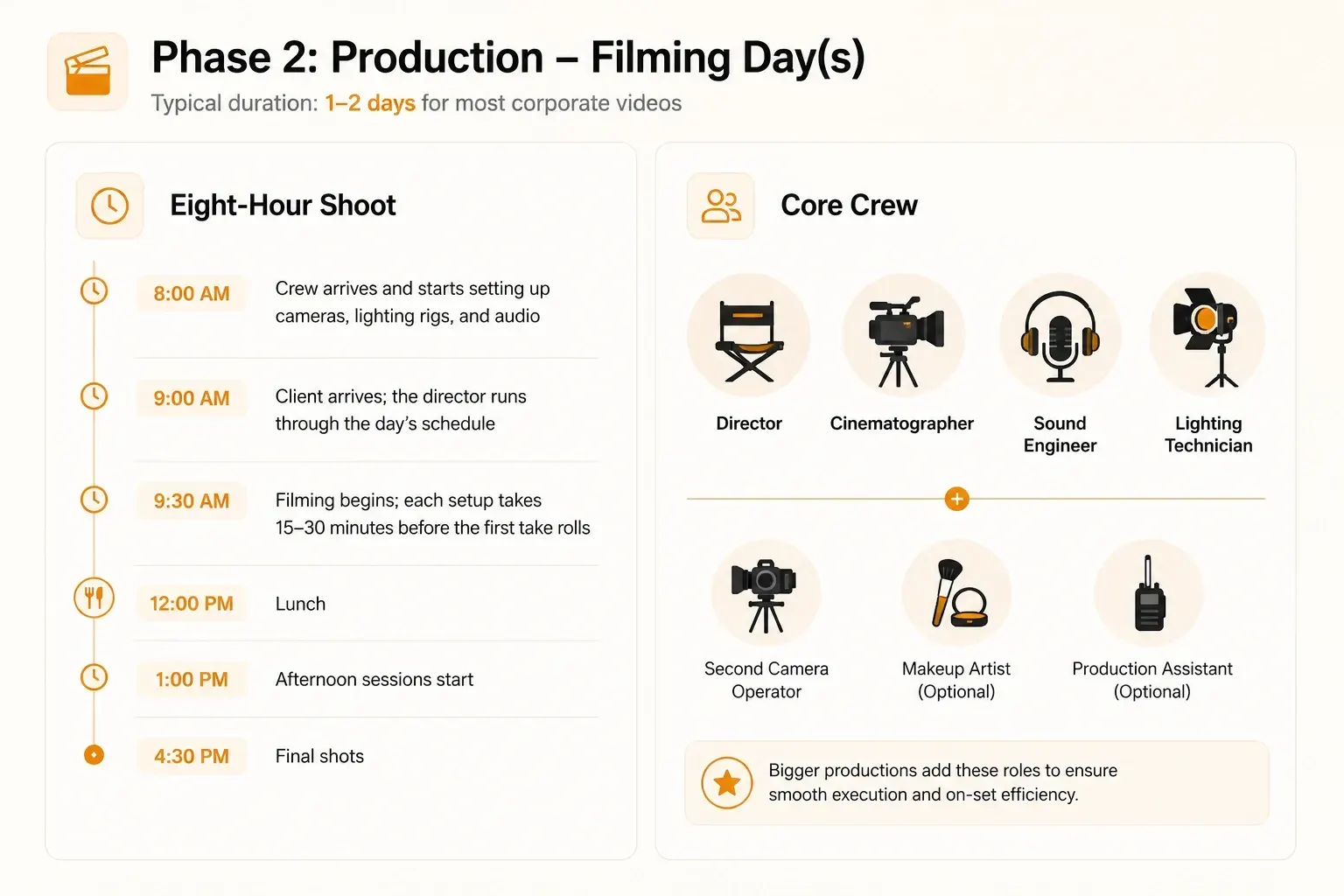
- 8:00 AM – Crew arrives and starts setting up cameras, lighting rigs, and audio
- 9:00 AM – Client arrives; the director runs through the day’s schedule
- 9:30 AM – Filming begins; each setup takes 15-30 minutes before the first take rolls
- 12:00 PM – Lunch
- 1:00 PM – Afternoon sessions start
- 4:30 PM – Final shots, then the crew breaks down
The core crew is a director, cinematographer, sound engineer, and lighting technician. Bigger productions may require a second camera operator, a makeup artist, or a production assistant to keep things moving.
As for the talents in front of the camera, we have a few suggestions. Wear solid colours because fine patterns create a moiré effect that looks terrible on screen. Know your talking points, but don’t memorise a script verbatim; rehearsed delivery reads as stiff. Multiple takes are standard. That’s not a reflection of performance; perfection takes time.
Filming in a Singapore office: Tell your building management team in advance. Book lift access for equipment. Get everyone in the office to silence their phones before a take. If your workspace faces a busy road, close the windows. CBD traffic bleeds into audio faster than most people expect.
Phase 3: Post-Production – Editing, Graphics, and Sound
Typical duration: 3-4 weeks
Post-production is the longest phase and the one clients tend to underestimate. Raw footage doesn’t cut itself into a polished video. After going through several distinct stages, it comes out to be the final video you see.
The Editing Stages
This stage requires multiple steps and focus points.
|
Stage |
Duration |
Who Sees It? |
Key Focus & Actions |
Tips for Success |
|
Assembly Cut |
2-3 days |
Internal team only |
The editor reviews footage, selects the best takes, and builds a rough sequence. |
Nothing is required from you yet. |
|
First Cut |
5-7 days |
Client (Your first review) |
Clips are sequenced with basic transitions and placeholder music. Focus on the big picture: story flow and key messages. |
Do not get distracted by colour or graphics yet; those come later. |
|
Revisions |
3-5 days per round |
Client & Editor |
Refined edits based on feedback. Standard projects typically include two rounds of revisions. |
* Use timestamps for actionable feedback (e.g., “at 0:34, swap for wide angle”). * Consolidate all stakeholder notes into one document before sending. * Avoid fragmented, trickling feedback. |
Changes within the filmed footage are included: shot order, timing, transitions, and music selection. New filming is not. Neither are major script changes or additional rounds beyond what was agreed.
Graphics and Motion Design (3-5 days)
Once the rough cut is approved, the graphics go in: name titles, logo animations, data visualisations if the script calls for them, and an end card. Send your logo as a vector file if possible, and double-check all name spellings and job titles before this stage begins. Fixing a misspelled title in a lower third after export is a surprisingly irritating process.
Singapore corporate video tends to favour clean, restrained graphics. Brand-colour lower thirds, simple transitions, subtle logo animation. Not everything needs to look like a broadcast commercial.
Colour Grading (2-3 days)
Colour grading makes all your footage look like it came from the same shoot, even if it was captured across different times of day or locations. It also sets the mood; warmer tones read as approachable; cooler and crisper tones read as authoritative. Your brand colours are matched here too.
Sound Design and Final Mix (2-3 days)
The audio mix balances dialogue, music, and any sound effects. The most common problem in corporate videos is that they skip proper sound work: the background music gradually overtakes the presenter until you’re watching someone’s mouth move with no idea what they’re saying. A proper mix keeps dialogue front and centre throughout.
Final Export and Delivery (1-2 days)
You’ll receive a master file at full resolution, a web-optimised version for faster loading, and platform-specific cuts for YouTube, LinkedIn, or Instagram if those were scoped. Files come through Dropbox, Google Drive, or WeTransfer, depending on size.
So, the post-production will look like this, week by week:
- Week 1: First cut
- Week 2: Client review and revisions
- Week 3: Graphics, colour, sound
- Week 4: Final pass and delivery
What the Project Manager Is Actually Doing?
People sometimes wonder what they’re paying for beyond the crew and the editing suite. A lot of it is coordination that never becomes visible because it’s handled before it becomes your problem.
On the logistics side, managers look over booking crew, scheduling locations, managing voiceover artists if needed, and running contingency plans. On the quality side, reviewing work internally before it reaches you and catching technical issues so you’re not the one finding them.
In practice, you have one contact for the entire project. You’re not chasing the editor to confirm they received footage from the cinematographer. You give feedback, you approve deliverables, and the rest is handled.
Is End-to-End Production the Right Call for Your Project?
It depends on what you’re making and what your team has capacity for.
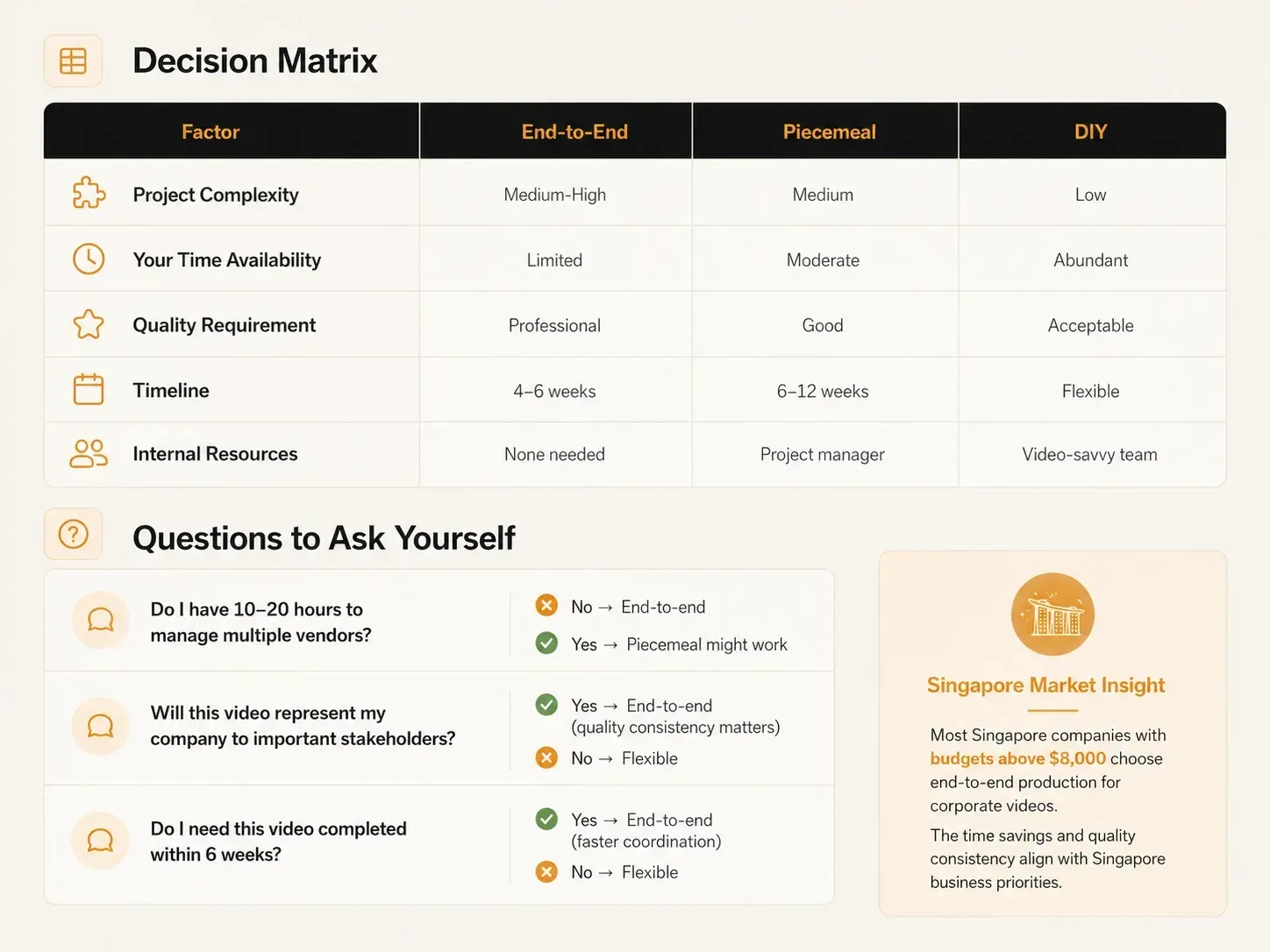
End-to-end makes sense when:
- Your video involves multiple locations or on-camera participants
- Needs substantial graphics
- Has a deadline that doesn’t allow for slow vendor coordination
- Or your team doesn’t have the hours to manage the process themselves.
It’s probably not necessary when:
- The project is a single-location shoot with minimal editing
- You have an in-house videographer who can handle parts of it
- Or budget constraints make a lighter approach more practical
The choice doesn’t have to be too tough; ask yourself the questions, and you’ll have your answers.
Know the Process Before You Start
Understanding the end-to-end corporate video production process before you brief a production company puts you in a much stronger position. You ask the right questions, set realistic timelines, give feedback that’s actually useful, and avoid the scope creep that catches most first-time clients off guard.
If you’d like to see how this process applies to your specific project, explore Moving Image’s corporate video production services. Or, browse the corporate video portfolio to see work produced for Singapore companies across finance, technology, and professional services.
FAQ
Frequently Asked Questions
Most corporate videos, like company profiles, product explainers, and recruitment films, take four to six weeks from kickoff to delivery. Pre-production runs one to three weeks, filming takes one to two days, and post-production runs three to four weeks. Projects with multiple locations, heavy animation, or many approvers will run longer.
Creative briefing, scriptwriting, storyboarding, all pre-production logistics, professional filming with a full crew, post-production editing, colour grading, sound design, motion graphics, revision rounds, and final delivery across required formats. Full service does not cover marketing strategy, media buying, or distribution.
With freelancers, you are the project manager. You brief each specialist, transfer files between them, consolidate feedback, and manage the schedule. With an end-to-end production company, a dedicated project manager handles all of that. The output quality can be comparable, but the difference is in your time, and in who’s accountable when something goes wrong.


